If you can see Mt. Baker, you are part of The Experience
If a final “Jeopardy!” clue was: “A brush, hammer, hog line, and biter have this in common,” a contestant might be tempted to respond with, “What are things you’d find on a farm?” But if their opponent answered with, “What are terms you’d hear while curling?” that second competitor would be declared the winner.
Curling is one of the world’s oldest known sports, with written evidence tracing it back to 1541 when a notary in Paisley, Scotland, recorded a challenge of stones thrown across a frozen pond between a monk and the lay governor of the abbey. Centuries later, the Scottish poet Robert Burns underscored the continued significance of the game when he wrote,
When Winter muffles up his cloak,
And binds the mire like a rock;
When to the loughs the curlers flock,
Wi’ gleesome speed…
In 2024, curling celebrated its 100th year as an Olympic competition and along the way has been designated an “official sport,” which means that a sport’s global appeal and popularity deem it to be worthy of inclusion on the official program. To illustrate that point, in 2022 the World Women’s Curling Championship’s bronze medal match pulled in more than half a million viewers, while a hefty 2.2 million American viewers tuned in to watch the inaugural Everest North American Curling Club Championships in 2025. With all these auspicious indicators of a winter sport steeped in history yet still as popular today as it was five hundred years ago, I decided it was time to experience for myself what all the fuss was about.
My curling sojourn took me not across “the pond,” but rather over the border to the north. A 30-minute drive from Lynden had me in the parking lot of the Abbotsford Curling Club, which traces its origins back at least 60 years.
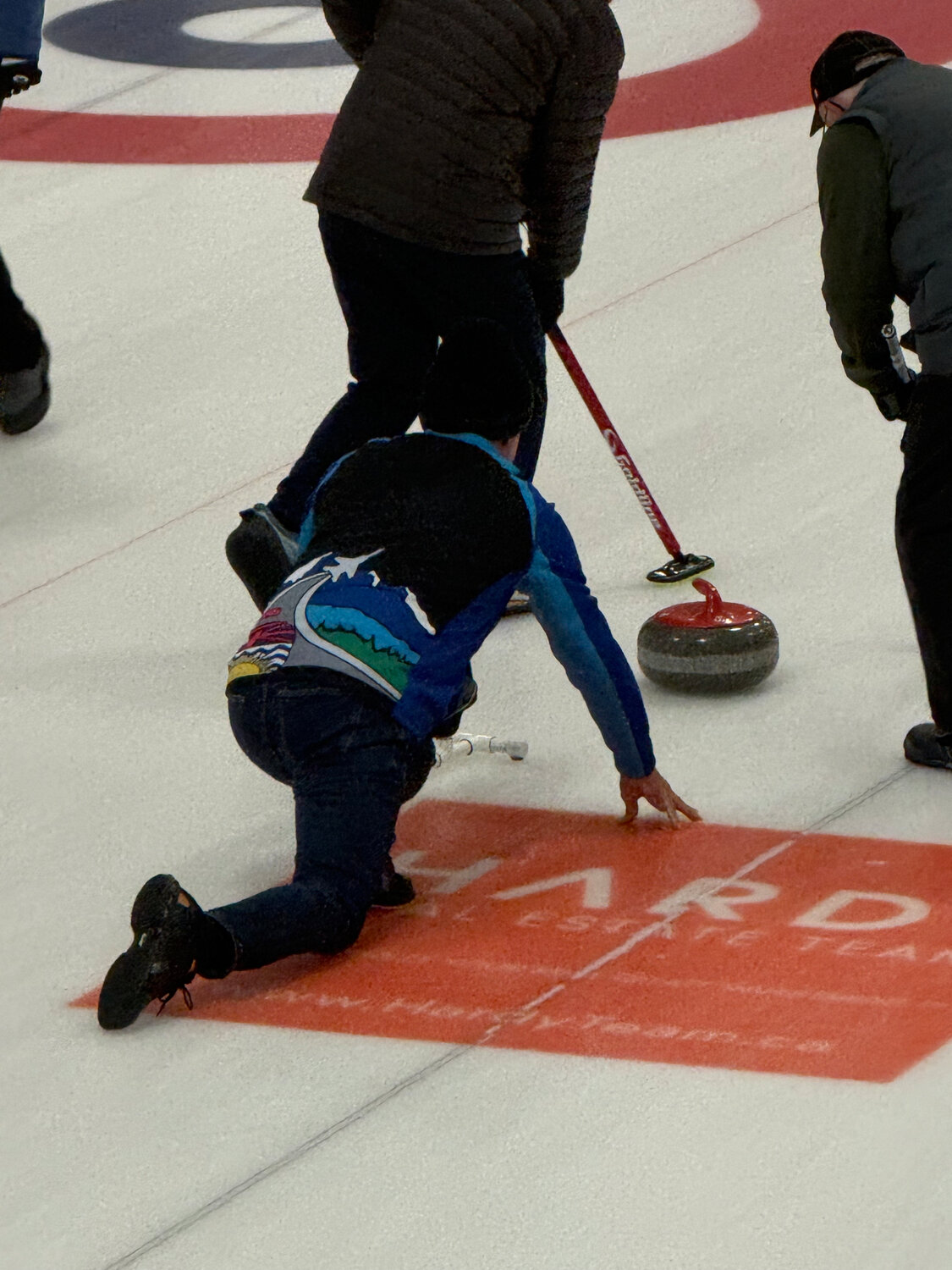
Entering the building, I wasn’t quite sure what to expect, but I did know that the time I’d selected was during the Thursday afternoon Masters’ Competitive. Out on the ice, dozens of curlers were actively engaged in co-ed competitions spread across six ice “sheets.” On each sheet, eight players were actively engaged in a game that looked to be a combination of shuffleboard and bowling played atop an icy field.
Curling is a civilized game, traditionally starting with the flip of a coin and a handshake to determine who goes first. Then two teams of four take turns sending a 38-44-pound granite stone (or “rock”) towards a 12-foot “house,” which consists of several concentric circles containing a bullseye (or “button”) in the middle of the house. Six to ten rounds, or “ends” are played with stones strategically cast and scores kept along the way.
The skip, oftentimes the captain of the team, determines the placement of the stone. The slider (the team member who pushes off from the “hack”) takes hold of the rock’s handle, and both will move forward towards the nearest “hog” (or release) line. Following that, brushing – which is done by two team members – will be done to control the speed and direction of the stone as it makes its way down the ice.
According to Smithsonian’s Science Education Center (SSEC), because each sheet is unique, “Curlers must master reading the ice to know how much a stone they throw will curl.” That explanation gives away a hint to curling’s most obvious question: Why is it called curling?
When a slider propels the granite stone forward, it will “curl” along its trajectory. Sometimes, a team wants the stone to move in a straight line; but other times, the curl of a stone can make all the difference between victory and defeat.
“The reason teams sweep the ice in a particular way is because the ice has been intentionally pebbled,” noted the SSEC. “Pebbling was designed to mimic the natural snow and pebbles that were on the ice when curling was played outside. If the ice was flat, the friction of the stone would be too high, and the rock would not travel half as far [so] ice technicians sprinkle two layers of water droplets on top of the ice to form two heights of bumps.”
Hoping to get a better view of the games being played inside the club, I walked upstairs for a birds-eye view of the action out on the ice. An affable barkeep was setting up for the après-game happy hour, and she asked me if I was a curler. I explained to her that I was just watching, but considering taking a lesson – which she told me you can on Monday nights during a five-week session. Equipment, along with instruction, is included in the fee, but beginners are encouraged to bring and wear a helmet.
I laughed at that, and quipped that I didn’t realize curling was a contact sport.
The barkeep narrowed her view and, like a grizzled professor to a wide-eyed student, explained to me that people do fall on the ice and sometimes hit their head on that 40-pound round block of granite.
So, note to self: wear a helmet. But also, don’t forget to bring a sense of fun. After all, it isn’t every winter’s day that you’ll have a chance to slide, sweep, or shout out on the ice participating in a sport that’s been played for half-a-millennium.
NOTE: Whether you’re looking to participate or spectate, there are opportunities to get familiar with the intricacies of curling at two local clubs (the Abbotsford Curling Club, or Seattle’s Granite Curling Club), or by attending a bonspiel (curling competition). X