If you can see Mt. Baker, you are part of The Experience
Do you like wilderness camping?
Do you like catching big fish?
Do you like seeing lynx, moose, grizzly and caribou?
Do you like being alone in the bush?
Do you like long drives?
If so, then you need to visit my neck of the woods, Takla Lake.
Takla Lake is in northwestern B.C. just over 171 km northwest of Prince George and approximately 1,000 km from the U.S./Canada border. From Prince George you drive west to Fort St. James. 40 km past “The Fort,” you turn off the main road and travel the last 125 km on logging roads. The road ends at a small seasonal resort called Takla Narrows. There are three small cabins, a very good boat launch and Wi-Fi. There are no other amenities.
Takla Lake is the fifth-largest natural lake in B.C. It is a fjord lake with steep mountains rising directly out of the lake. The lake is shaped like a “Y” with the main arm stretching 96 km long and the northwest arm, on which our cabin is located, at 40 km long. Being a fjord lake, there is very little flat land on which to build a cabin, and the lake is extremely deep. Right in front of our cabin, the lake is over 260 meters deep (approximately 850 feet) in front of our cabin.
Takla Lake has a rich history. It was one of the routes used to get to the Ominica goldfields in the 1870s. Miners that chose the Takla Lake route used small boats or canoes to navigate the rivers and lakes, but in 1871 a group of Quesnel businessmen believed they could make their fortune by having a sternwheeler carry prospectors from Quesnel to the goldfields. At this time, no boats went past Quesnel as they could not get through the Fort George Canyon.
In late June of 1871, the Enterprise, a 110-foot-long sternwheeler with a full load of gold miners pulled out from the dock at Quesnel into the Fraser River and through the canyon, and then on to Takla Lake some 350 km away. This was a remarkable trip that took five weeks over extremely dangerous rivers. After dropping the gold miners off at the end of Takla Lake, the Enterprise started the return trip to Quesnel to pick up another load of miners but ran aground on Trembleur Lake and sank. Her boilers can still be seen rusting on the edge of the lake.
But that wasn’t the end of big transportation dreams along Takla Lake. In the late 1960s, B.C. Railway decided to extend the rail line 663 km from Fort St. James to Dease Lake near the B.C. Yukon border. Over 90 km of the line runs along the shore of Takla Lake. The line was abandoned in 2006, but the steel tracks are still in place. These days, many retrace the route that the Enterprise took in 1871 and canoe from Takla Landing through Takla Lake and the connecting rivers and lakes to Fort St. James. This is a 190 km paddle, and it takes three to four days.
My wife Ann and I live at Takla Annie on the northwest arm of Takla Lake. We park our truck at the end of the road at the Narrows and travel up the Arm by boat. When I asked if you liked being alone in the bush, I wasn’t kidding. There are five seasonal cabins on the northwest arm that are occupied on and off during the summer. The nearest one is nine km from our cabin. Our nearest full-time neighbour is 43 km away by boat. By the middle of September, we are the only people still on the Northwest Arm and this becomes a big issue if we need help of any kind. Any major boat problems mean we can’t get back to the truck. Any major medical problems and ... well, we're toast.
Our log cabin was built in 1969 and is approximately 750 square feet consisting of a kitchen and dining area, two bedrooms, a storage area and a bathroom with a shower and toilet. There is also a guest cabin that sleeps three. We rely on solar panels (with generator backup) for electricity and have 500 meters of 2-inch pipe that provides pressurized water from the creek on our property. We also have internet and phone service via satellite. So, while we are isolated in the sense of having no nearby neighbors, we do not lack any comforts.
So, what do we do with all our time?
We kill a lot of mosquitoes and black flies in June and July. If you make the long drive to Takla Lake or anywhere in northern B.C., bring bug spray.
We do a lot of fishing. Takla Lake has 15-pound rainbow trout, 20-pound lake trout and 35-pound burbot in it. There are supposed to be sturgeon in the lake but no one has ever caught one. Most people troll for the rainbows and lake trout, but the rainbows readily take a fly like an “egg sucking leach” at the creek mouths when the salmon are running. Imagine a 10-pound rainbow trout dancing across the water on the end of your fly line – now that's a fight you'll remember. We also fish for burbot using a set line which is a rig that consist of a float with at least 150 feet of line tied to a very large, baited hook with a three-pound weight to stop it from floating away. The set line is put in very deep water and left over night. The largest burbot that we have caught was 16 pounds and three feet long. (A burbot is an elongated bottom-dwelling fish that is the only member of the cod family to live in fresh water. It tastes just like the saltwater version.)
We do a lot of exploring. There is an area farther up the lake where we search for fossils. We take our grandkids and other guests up there to find fossils of plants, clam shells and ammonites. We have found numerous old trapper cabins out in the bush and along the shore. There are several waterfalls along the lake and one over 100 feet high on the creek that goes through our property.
Ann has a flower patch and a small vegetable garden. She also has a chair and several fishing rods at the mouth of the creek where she catches dinner on a regular basis.
We kill a lot of mosquitoes and black flies in June and July ... oops, I already said that!
We entertain family and friends who want to escape the city, sit around a campfire and cook a hot dog on a stick, sleep in on a Monday morning if it suits them, go catch a fish, or do absolutely nothing.
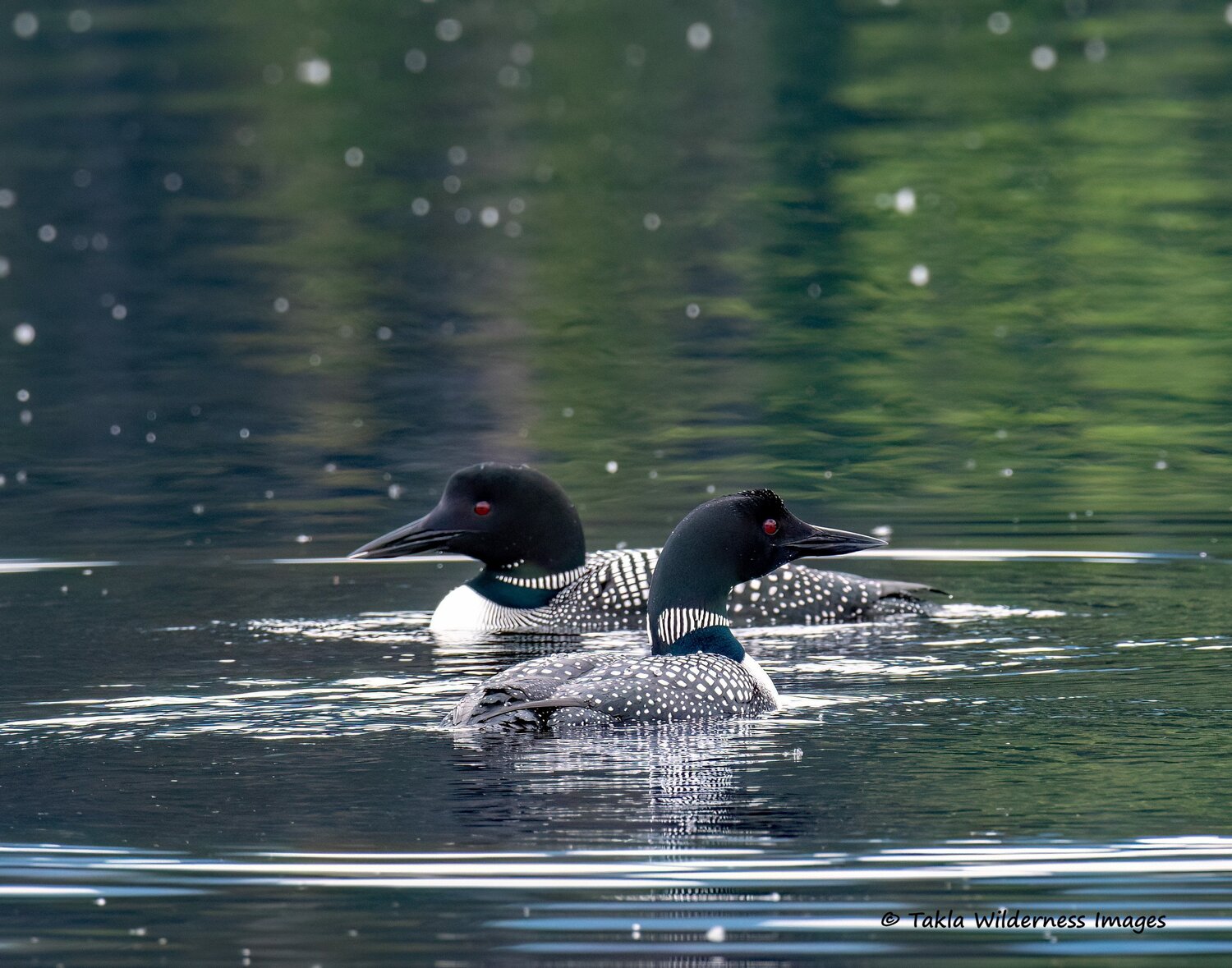
Being a wildlife photographer, I'm out in the bush almost every day. I have packed lumber into various locations and built comfortable blinds that keep me dry when it is raining, warm on cold fall days and prevent the birds or animals from seeing me. My photographer friends tell me I'm getting soft. I tell them I'm getting smarter. There are owls, kingfishers, grebes, mergansers, moose, elk, black bears, grizzlies, fishers, mountain goat, Canada lynx and wolves wandering around here. It is not easy. You have to work hard to get the picture. This isn’t Jasper, Banff or Yellowstone where the animals are used to people and stand around posing until you get the shot. Here, when large animals see you, they either run away or run at you.
We travel back to Prince George once a month to stock up on food, fuel and other necessities like bug spray. It usually takes five or six days before we make it back to Takla Annie. We have a lot to do in those five or six days. Ann’s grocery list is up to three pages long and always includes Hawkins Cheezies and numerous chocolate bars. I get a lot fewer things, but it still takes time, plus there is always business matters that must be done in person, medical appointments and meeting friends and family. There is a lot compressed into a short time. It’s hectic and we always look forward to the return trip to Takla Annie.
So, should you make the long drive to Takla Lake or for that matter, any of the big lakes in northern B.C.? The answer is definitely yes if you are on your way to Alaska. But take the less travelled route; instead of continuing north at Prince George you turn west and just past Terrace take the scenic Stewart-Cassiar Highway that reconnects with the Alaska Highway at Watson Lake in the Yukon. On the return trip home you can follow the Alaska Highway all the way and then compare that route to your trip north. I've travelled both and the Cassiar-Stewart is, in my opinion, the more scenic route. Bring your camera and of course, lots of bug spray.
See you soon north of the border, eh! X